
TIRAGES DU PODCAST
You've listened to the story behind a photograph on the 101 Visages podcast?
You can purchase that photograph, as well as those featured in other episodes, in this carefully curated selection, available as numbered, signed collector’s prints or open editions.
The collection includes vintage prints, Cibachrome prints by Roland Dufau, Baryta prints, and Lambda prints, all produced under Reza’s supervision.
Each piece comes with a certificate of authenticity.
Discover the collection.

Testimonies of Imprisonment - Incarceration in France
In this episode, photographer Reza explores the deep connections between imprisonment, human dignity, and the French prison system. From his past as a political prisoner in Iran to his work at the Liancourt Correctional Facility, where he was commissioned by the French government to produce a series of photographs, he examines the human condition within places of confinement.
He is thus confronted once again with the walls—both real and symbolic—of incarceration. His humanistic perspective raises a fundamental question: how can one depict prison without betraying those who live there, and without reducing their humanity to their prison conditions?
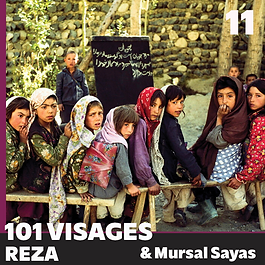
Afghan Women - Transmissions
In this episode, Reza looks back on his connection with Afghanistan since 1983 — his many visits, his reporting, and the work of his foundation in support of Afghan women — as well as his encounters with women and children whose daily lives reveal as many challenges as they do moments of courage and solidarity. As a guest, Mursal Sayas, an Afghan journalist, writer and activist who fled Kabul in 2021, shares her journey and the reality facing women on the ground since the Taliban's return to Afghanistan, and the repressive policies imposed on those who remained.
Her book "Who Will Hear Our Cries?" is available from Éditions de l'Observatoire.
This episode is produced in partnership with Voix en Exil, a project led by SINGA Paris, the French media development agency CFI, Reporters Without Borders, and the Maison des Journalistes, with the support of the French Ministry of Foreign Affairs.

Azzedine Alaïa - Curves and marble
For decades, Azzedine Alaïa dressed bodies the way others sculpt marble — with precision, intuition and passion. A discreet yet visionary couturier, he reshaped the codes of fashion from his Parisian atelier, far from the spotlight but close to the fabrics and the women he sought to elevate. In this episode, Reza shares his encounter with the designer in the intimacy of his studio, on the day he photographed him. Through his lens, he recalls how he tried to capture, in images, the profound love Alaïa held for women — he who drew ideal silhouettes, somewhere between living curves and sculpted marble, as if in pursuit of perfection and grace.
In the second part of the episode, Camille Liu, a knitwear designer and specialist, sheds light on Azzedine Alaïa's legacy. She examines how he redefined haute couture through a craft-based and intimate approach, how his refusal to conform to industry norms can be read as a form of cultural resistance, and what his work continues to inspire today in a fashion world increasingly driven by speed, branding and the ephemeral.
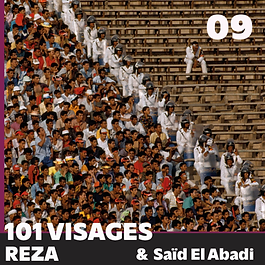
The round ball
Egypt. 1991
In this episode, Reza reflects on his work in the heart of Cairo, where he documented the legendary matches between Al-Ahly and Zamalek. Far more than just sporting events, these confrontations embody the social and political tensions of contemporary Egypt. Through his photographs, Reza captures the intensity of the rivalry, the passion of the fans, and the raw energy of the stands, revealing a spectacle that is at once popular, festive, and sometimes explosive.

Wind in the grave
Rwanda. 1994
In the 1980s and 1990s, HIV wreaked havoc around the world. Reza reflects on the early days of the virus and how sub-Saharan Africa became the silent epicenter of the epidemic. While the virus struck the West, it took deep root in Africa, affecting millions of lives amid widespread indifference.
During his trip to Rwanda in 1992, Reza captured the traces of this invisible crisis through his photographs.

Time of war
Sarajevo, 1993
In this episode, Reza takes us to Sarajevo in 1993, a city devastated by war. Amid snipers, checkpoints, death, and cold, he witnesses the horrors of the siege… but also a surprising glimpse of humanity: the encounter with a little girl, a symbol of hope in the midst of chaos.
Alongside Sophie Gueudet, historian and specialist in separatist conflicts and contested territories in the post-Yugoslav and post-Soviet spaces, we revisit the war in Bosnia-Herzegovina: from the fall of Yugoslavia to the ethnic divisions that shaped the conflict.

Libya under Kadhafi, The Shepherd
Lybia. 2000
For over forty years, Gaddafi shaped Libya through his authoritarian rule, economic reforms, and pan-African ambitions. Coming to power in 1969, he imposed a unique political model, combining state control with the ideology of the *Green Book*. Reza, one of the few journalists to have met him, recounts this encounter at the heart of an opaque regime.
With the help of Virginie Collombier, PhD in Political Science and specialist in the Arab world and the Middle East, we explore the mechanisms of power that allowed the regime to endure and the reasons behind its sudden collapse in 2011.

The capture of Kabul
Kabul, 1992
What is happening in Afghanistan on the brink of a new civil war? Reza joins his friend Ahmad Massoud, a central figure of the Afghan resistance, during the capture of Kabul. At the heart of this account lies the complexity of the relationships between Afghan warlords: how long can they remain united once their common enemy has disappeared?
Drawing on this experience, Bertrand Badie analyzes the country’s internal dynamics as well as its role on the international stage, highlighting the influence of several foreign powers — beyond Russia alone — in this slide toward civil war.

Portraits of lost children
Refugees camp. Goma. 1995
In this episode, Reza takes us to the heart of a tragic moment in history: the genocide in Rwanda. He is joined by Juliette Bour, PhD in History from the EHESS and postdoctoral researcher at the Centre for Urban History at the University of Antwerp, a specialist of this period, particularly of the still little-known role of women among the perpetrators.
Together, they trace the origins of the genocide, explore the realities of Tutsi and Hutu refugee camps, analyze the role played by France, and examine the immense challenges of rebuilding a country marked by such a tragedy. They also look at the justice mechanisms that were put in place, the politics of memory, and the strategies of national reconciliation—essential elements for understanding how Rwanda, even today, continues to heal its wounds and build a stable future.

On the banks of the Amur River
Russia, 1999
In this episode, Reza takes us to the banks of the Amur River, where he meets Sergei Vassilievitch, a man bearing an enigmatic tattoo that traces a ten-year-long journey of wandering. From this encounter, Kevin Limonier immerses us in the world of the “thieves-in-law,” Soviet criminals paradoxically linked to those in power, notably through their presence in the Gulag camps.
This story reveals the conditions of detention in these camps, brought to light after the fall of the USSR. Between disillusionment, identity reinvention, and the weight of the past, this episode questions how societies rebuild themselves after the collapse of grand ideologies.

The Prince
Cambodia, 1996
In this episode, we travel to Phnom Penh in 1996, where mountains of Western waste give rise to entire villages within the city’s landfills. Through the eyes of “the Prince,” a young boy born into this world, we discover the reality faced by children who survive on trash shipped from abroad.
With Delphine Darmon — podcaster and author of Demain n’attend pas, entrepreneur, and ESG transformation expert — we explore the hidden side of this overlooked global trade: why do our waste products end up so far away? And at what cost?

Massoud, The Peace warrior
Afganistant, 1985
In this first episode, we revisit an iconic image captured by the photographer Reza: his remarkable encounter with Commander Massoud. Through this photograph, Reza recounts the exact moment he took the picture that would later become famous. At the same time, political scientist Bertrand Badie sheds light on the historical and geopolitical context of the period: why the Soviet Union invaded Afghanistan, how the war unfolded, who was involved, and how it ultimately came to an end.